
Oil soft on oversupply worries, easing Iran risks


USOIL Analysis
The US President stated his "preference" for a diplomatic solution with Iran [1] and referred to nuclear talks that could stretch "over the next month" [2]. These remarks reduce the likelihood of a near-term military strike, easing supply disruption risks. This keeps the focus on prospects of an oil glut, as supply growth is expected to outstrip consumption, barring any major shock.
A successful outcome in the Iran negotiations and the diplomatic efforts for a Ukraine peace could add more crude to an already well-supplied market. At the same time, the United States is rolling back sanctions on Venezuela and the US Energy Information Administration expects the country's output to return to pre-blockade levels in the first half of the year [3]. On the demand side of the equation, trade frictions and broader macroeconomic uncertainty continue to dampen consumption. Underscoring these headwinds, the International Energy Agency lowered its 2026 demand growth outlook this week. [4]
USOil is at risk of its first back-to-back weekly decline as the outlook remains decisively bearish amid a looming surplus. Unfavourable fundamentals leave prices vulnerable to deeper pullbacks that would bring the 2025 low (54.96) into focus. However, this year's advance has improved the technical backdrop and, above the EMA200, USOil retains the near-term initiative and the potential to set new 2026 highs (66.49). Recovery prospects can also be supported by subtle shifts in fundamentals.
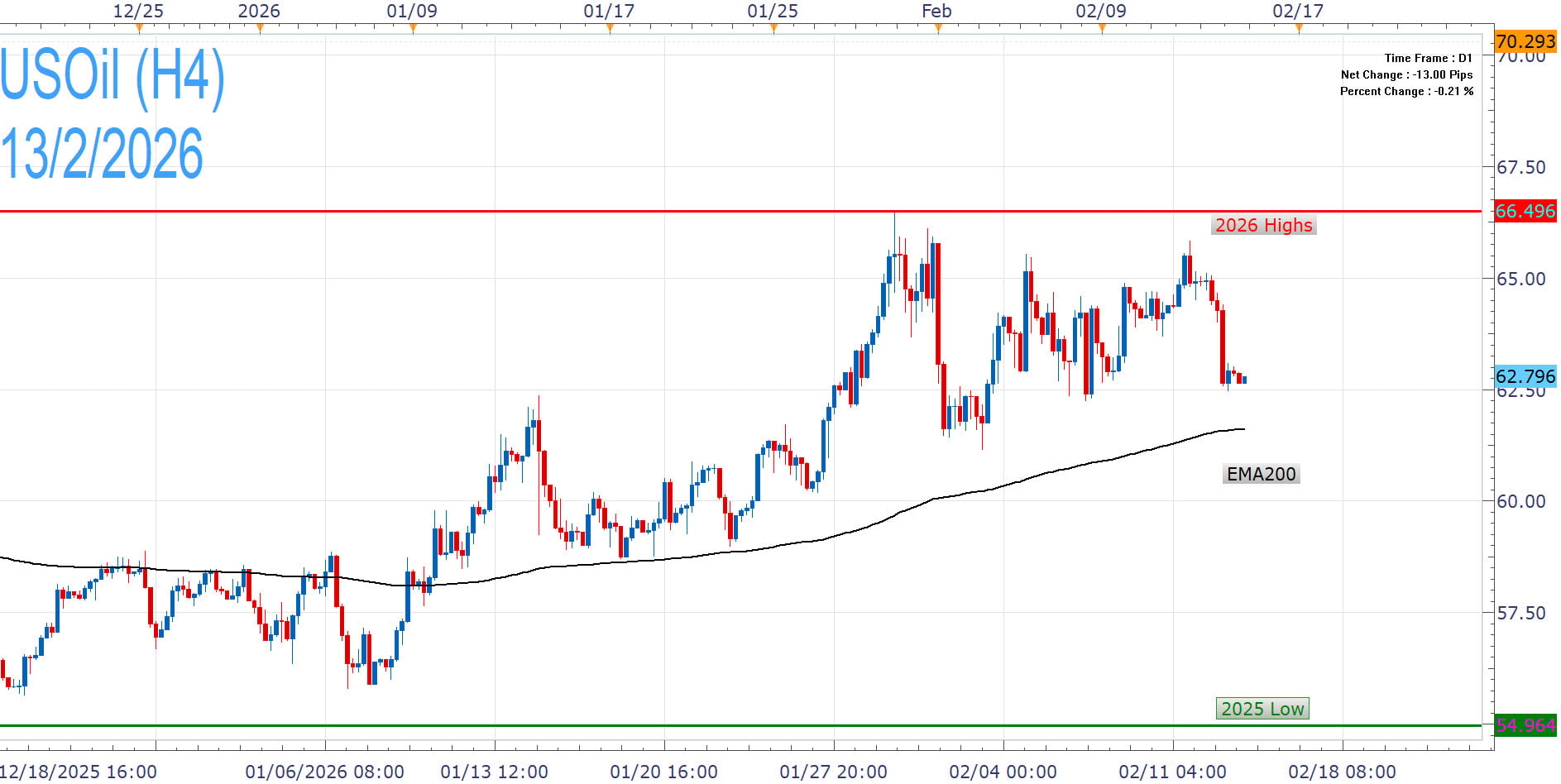
The risk premium could spike at any time as geopolitical tensions and supply risks persist. President Trump's recent rhetoric was hardly conciliatory, stressing that failure to reach a fair deal would be "very traumatic" for Iran. Highlighting the fragile situation, the US shot down an Iranian drone last week that was "acting aggressively" towards the USS Abraham Lincoln in the Arabian Sea, according to US Press Secretary Karoline Leavitt. [5]
Moreover, Venezuelan oil output remains modest in global terms and restoring the country's capacity is a lengthy and complex process. OPEC+ has paused its production hikes in Q1 and, while it could still return more barrels to the market, the group is likely to proceed cautiously. On the demand side, consumption could still increase this year as the global economy normalises from last year's tariff shocks, while China's strategic stockpiling is set to continue.

Nikos Tzabouras
Senior Financial Editorial Writer
Nikos Tzabouras is a graduate of the Department of International & European Economic Studies at the Athens University of Economics and Business. With extensive experience in market analysis and a strong foundation in international relations, he brings a unique perspective to financial markets. Nikos emphasizes not only technical analysis but also on fundamentals and the growing influence of geopolitics on financial trends.
As a Senior Financial Editorial Writer, he delivers comprehensive and forward-looking insights across a wide range of asset classes, including equities, commodities, and currencies. His work explores how macroeconomic events, political developments, and global policies impact market dynamics, providing readers with a deeper understanding of both short-term movements and long-term trends.
References
| Retrieved 13 Feb 2026 https://truthsocial.com/@realDonaldTrump/posts/116053512461029874 | |
| Retrieved 13 Feb 2026 https://www.youtube.com/watch | |
| Retrieved 13 Feb 2026 https://www.eia.gov/outlooks/steo/pdf/steo_full.pdf | |
| Retrieved 13 Feb 2026 https://www.iea.org/reports/oil-market-report-february-2026 | |
| Retrieved 19 Sep 2026 https://x.com/RapidResponse47/status/2018750270235431043 |



Any opinions, news, research, analyses, prices, other information, or links to third-party sites contained on this website are provided on an "as-is" basis, as general market commentary and do not constitute investment advice. The market commentary has not been prepared in accordance with legal requirements designed to promote the independence of investment research, and it is therefore not subject to any prohibition on dealing ahead of dissemination. Although this commentary is not produced by an independent source, Friedberg Direct, FXCM or its affiliates takes all sufficient steps to eliminate or prevent any conflicts of interests arising out of the production and dissemination of this communication. The employees of Friedberg Direct and FXCM commit to acting in the clients' best interests and represent their views without misleading, deceiving, or otherwise impairing the clients' ability to make informed investment decisions. For more information about the Friedberg Direct's internal organizational and administrative arrangements for the prevention of conflicts, please refer to the Firms' Managing Conflicts Policy. Please ensure that you read and understand our Full Disclaimer and Liability provision concerning the foregoing Information, which can be accessed here.**