
Netflix drops Warner Bros bid amid superior rival proposal, but the stock can benefit


Netflix withdraws WBD bid
Netflix had reached an agreement in early December to acquire the television and film studios of Warner Bros for $27.75 a share [1], but Paramount Skydance continued to pursue the company and all of its assets. After a waiver to reopen talks, Warner Bros Discovery concluded on Tuesday that Paramount's $31 a share bid constituted a "superior" offer. [2]
Netflix did not exercise its right to amend the proposal and declined to raise its price. The company noted that the deal was "no longer financially attractive" and described the transaction as "nice to have" but "not a must have" at any price. [3]
If Netflix indeed sticks to its withdrawal from this transformative deal, what would be the implications for its business and stock?
The Good
Under the revised all-cash offer, Netflix would have leveraged its balance sheet and taken on tens of billions in new debt, potentially eroding investor confidence in a challenging environment [4]. The company also projected roughly $275 million in acquisition-related expenses for 2026 in its latest earnings report [5], which would have strained margins. By withdrawing its bid, the streaming giant avoids these obligations, retains greater flexibility over capital allocation and will resume its share repurchase programme, returning value to shareholders.
Netflix will also steer clear of non-monetary hurdles. The acquisition carried considerable regulatory and integration risks, requiring time, effort and resources that could distract management. Given its potential impact on the media industry, the deal would likely face intense scrutiny and could require significant concessions, particularly given the transactional nature of the current administration. Moreover, Warner Bros is a vast and far-reaching organisation, making integration a complex undertaking.
The Bad
The growth runway from the password-sharing crackdown and the launch of the ad-inclusive tier is narrowing. Subscribers rose 7.6% last year, far slower than in 2024 at 16%, and management engagement has been largely flat. Netflix also expects revenue growth to moderate to 12%–14% this year, down from a 15.9% rise in 2025. Acquiring Warner Bros could have provided the next growth catalyst.
Netflix would gain a major intellectual property injection through a deep catalogue of hit films and shows, including HBO – TV's perennial success story. It would also benefit from an influx of new subscribers, with Warner having 131.6 million streaming users at the end of the fourth quarter [6]. In addition, Netflix would expand its presence in legacy Hollywood through Warner's studio and film empire.
The latest earnings report showed that Netflix can maintain momentum with broadly solid results and guidance, but this largely hinges on the success of its strategic pivot to advertising. Management expects advertising revenue to double this year, yet despite its streaming dominance, Netflix remains a relatively small player in the wider media landscape. A tie-up with Warner Bros would significantly expand its footprint and advertising leverage, accelerating its commercial potential.
Netflix could also face a more powerful rival if the WBD-Paramount merger goes ahead. This would occur during a period of intense competition and macroeconomic uncertainty that reduces consumer appetite for multiple subscriptions.
Netflix stock outlook
Netflix's withdrawal could push the stock higher and set the stage for a recovery that negates the current bearish bias. The company avoids acquisition-related costs and debt and does not risk cannibalising its core streaming business.
Markets never fully embraced the acquisition. The stock has fallen since the 5 December agreement and continued to decline after the revised proposal on 20 January. However, it rebounded after Netflix allowed WBD to reopen talks with Paramount Skydance on 17 February.
That said, Netflix misses a strong opportunity to expand its user base, content portfolio and overall business. This could leave it vulnerable, particularly if the WBD-Paramount deal is completed, while depriving it of a growth catalyst at a transitional moment. Over the longer term, this could cap the stock's upside and leave it exposed to deeper declines.
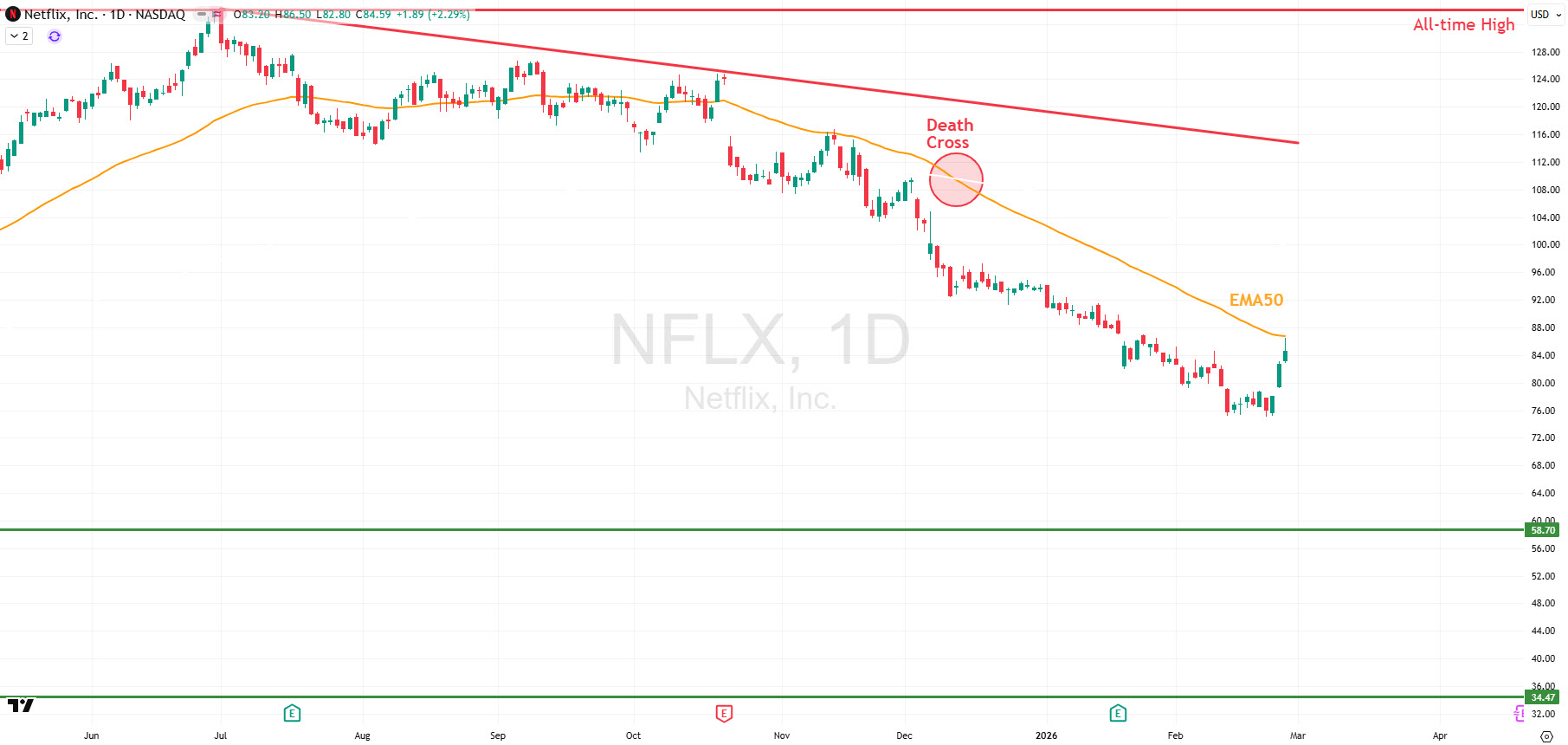
Chart source: www.tradingview.com

Nikos Tzabouras
Senior Financial Editorial Writer
Nikos Tzabouras is a graduate of the Department of International & European Economic Studies at the Athens University of Economics and Business. With extensive experience in market analysis and a strong foundation in international relations, he brings a unique perspective to financial markets. Nikos emphasizes not only technical analysis but also on fundamentals and the growing influence of geopolitics on financial trends.
As a Senior Financial Editorial Writer, he delivers comprehensive and forward-looking insights across a wide range of asset classes, including equities, commodities, and currencies. His work explores how macroeconomic events, political developments, and global policies impact market dynamics, providing readers with a deeper understanding of both short-term movements and long-term trends.



Any opinions, news, research, analyses, prices, other information, or links to third-party sites contained on this website are provided on an "as-is" basis, as general market commentary and do not constitute investment advice. The market commentary has not been prepared in accordance with legal requirements designed to promote the independence of investment research, and it is therefore not subject to any prohibition on dealing ahead of dissemination. Although this commentary is not produced by an independent source, Friedberg Direct, FXCM or its affiliates takes all sufficient steps to eliminate or prevent any conflicts of interests arising out of the production and dissemination of this communication. The employees of Friedberg Direct and FXCM commit to acting in the clients' best interests and represent their views without misleading, deceiving, or otherwise impairing the clients' ability to make informed investment decisions. For more information about the Friedberg Direct's internal organizational and administrative arrangements for the prevention of conflicts, please refer to the Firms' Managing Conflicts Policy. Please ensure that you read and understand our Full Disclaimer and Liability provision concerning the foregoing Information, which can be accessed here.**