Understanding margin

What it is, how it works, and how to calculate it

When you trade CFDs or forex on leverage, margin is the deposit you set aside to open and maintain your positions. It is not a fee, it is a portion of your account equity held as collateral. Understanding how margin works gives you greater control over your risk and helps you manage your exposure with precision.

What is leverage?

Leverage allows you to control a larger position than your account balance would otherwise permit. For every unit of currency you commit as margin, your broker effectively extends your buying power by a set multiple.

For example, with 400:1 leverage on a major forex pair, you can control $400,000 in the market by setting aside just $1,000 as margin. The formula is straightforward:

Formula

Required margin =
position size ÷ leverage

Your margin is a fraction of the total position

Example

$400,000 ÷ 400
= $1,000 margin

Set aside as collateral to open the trade

Without leverage

$1,000

You control

$1,000

in the market

400:1

leverage

With leverage

$1,000 margin

You control

$400,000

in the market

Leverage and margin at a glance

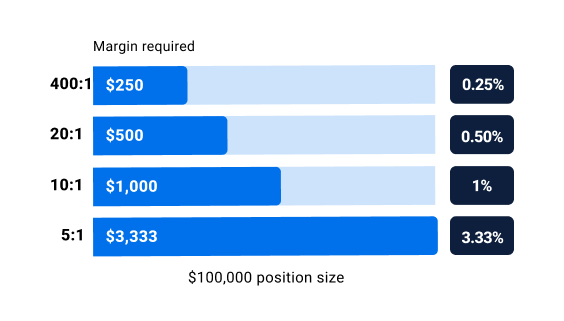
The relationship between leverage and margin is inverse. Higher leverage means a lower margin requirement, and vice versa.

Leverage and
margin at a glance

Formula

Leverage = 1 ÷ margin %

Example

400:1 = 1 ÷ 0.25%

Leverage and margin at a glance

Types of margin

Entry margin (use margin) – the deposit required to open a position. You can view this figure per instrument before you place a trade.

Liquidation margin – the minimum equity threshold your account must maintain. This is typically set at 50% of the maintenance margin. If your equity falls below this level, your positions may be closed automatically to prevent further losses.

Types of margin

Entry / maintenance margin MMR

Initial deposit required to open and keep a position open. Viewable per instrument before placing a trade.

Margin warning

Equity has dropped below maintenance margin but remains above liquidation level. No new positions can be opened until equity recovers.

How margin is calculated

Forex margin

Forex margin is calculated as a percentage of the notional value of your trade. The notional value is the full size of the position in the counter currency.

Step 1: Notional value

Notional =

Size × Price

The full value of the position in counter currency


Step 2: Margin

Margin =

Notional × Margin %

Your margin is a fraction of the total position

Example · Buying EUR/USD

Step 1
10,000 × 1.1200
$11,200

Step 2
$11,200 × 3.33%
$373
At 30:1 leverage, a $11,200 notional position requires just $373 as collateral.

CFD margin
CFD margin works similarly, but the notional value calculation includes a multiplier – a factor specific to each instrument that scales the contract to an appropriate size.

Notional value

Notional =
(Price × Multiplier) × Contract size

Leverage

Leverage =
Notional ÷ Margin required

Example

Trading GER40 (DAX) · 5 contracts at 18,250

Step 1 · Notional

(18,250 × 0.1) × 5
€9,125

Step 2 · Margin

€14 × 5 contracts
€70

Step 3 · Leverage

€9,125 ÷ €70
130:1
With €70 in margin, you control €9,125 worth of GER40 exposure.

Effective leverage

Effective leverage measures how much of your total account equity is being used relative to the combined notional value of all your open positions. It is a useful gauge of your overall risk exposure.

Example
$70,000
Total Notional
÷
$10,000
Equity
=
Effective leverage gauge
7:1
Effective leverage

Stay in control of your margin

Managing margin effectively is central to disciplined trading. A few practical steps can help you maintain a clear picture of your exposure and avoid unwanted liquidations.

  • Monitor your effective leverage. Keep it at a level you are comfortable with, and be aware of how additional positions change the ratio.
  • Use stop-loss orders. Define your risk per trade in advance. Stops are executed as market orders – they guarantee execution but not price.
  • Check margin requirements before you trade. Requirements can change to reflect market volatility and exchange rate movements. Review the entry margin for each instrument before placing an order.
  • Maintain adequate free margin. Having a buffer of available equity gives you room to absorb short-term market fluctuations without triggering a liquidation.