
USD/JPY extends its drop amid lingering USD headwinds despite strong NFPs


USD/JPY Analysis
The United States added 130,000 jobs in January, the best performance in more than a year, while unemployment pulled back to 4.3%, the lowest since August. Labour market resilience, coupled with persistent price pressures and macroeconomic uncertainty, raises the bar for additional Fed easing. This can be supportive for the USDOLLAR, along with easing independence concerns after the nomination of a Fed insider to succeed Chair Powell.
Meanwhile, the landslide victory of PM Takaichi in Sunday's Japanese election [1] can embolden her to push forward with her stimulus agenda, which can create significant headwinds for the Yen. Such expansive policies raise concerns about their funding and the fiscal position of the most indebted nation in the world according to the International Monetary Fund (IMF), with a 226.8% debt-to-GDP ratio. [2]
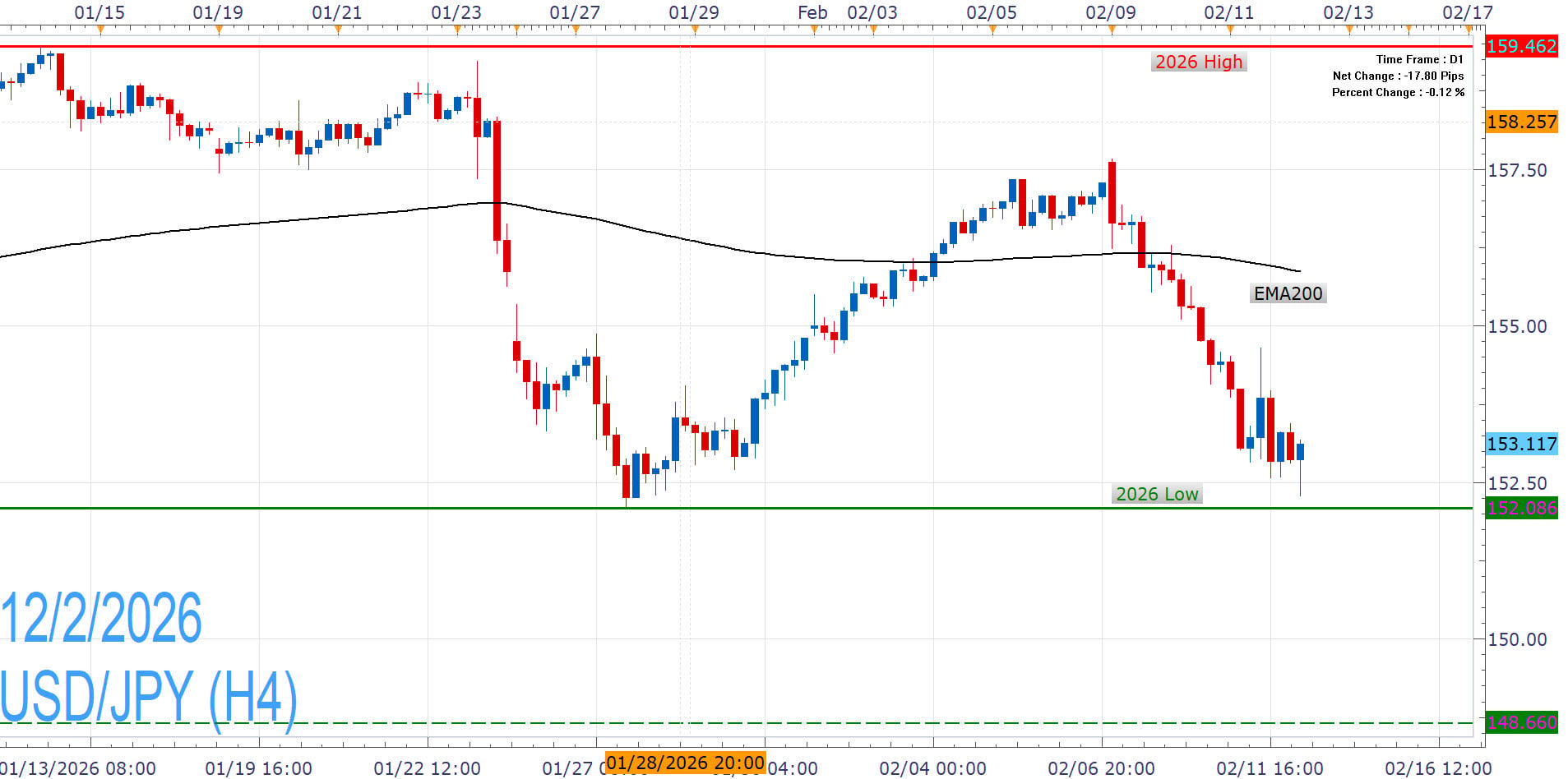
The strong NFPs that make Fed cuts harder, along with yen challenges from Japan's stimulus dynamics, can help USD/JPY rebound towards the pivotal EMA200. A move above it would reinstate the bullish bias and put the greenback back on track for new multi-year highs. However, a sustained recovery looks tough, and the pair remains exposed to deeper declines on fundamental headwinds.
The monetary policy dynamics are unfavorable, as the Bank of Japan is committed to its tightening cycle, while markets continue to expect two rate cuts by the Fed, and the next Chair may be more attuned to President Trump's preference for lower borrowing costs. Furthermore, dollar weakness is likely to persist, as it is well founded on disruptive trade policies and debt worries.These were brought back into the spotlight this week, as the Congressional Budget Office (CBO) raised its outlook, now expecting deficits to increase by $4.7 trillion in 2026–2035 due to the One Big Beautiful Bill [3]. At the same time, Japanese authorities have repeatedly warned of FX intervention to support the Yen in case of further weakness and volatility.

Nikos Tzabouras
Senior Financial Editorial Writer
Nikos Tzabouras is a graduate of the Department of International & European Economic Studies at the Athens University of Economics and Business. With extensive experience in market analysis and a strong foundation in international relations, he brings a unique perspective to financial markets. Nikos emphasizes not only technical analysis but also on fundamentals and the growing influence of geopolitics on financial trends.
As a Senior Financial Editorial Writer, he delivers comprehensive and forward-looking insights across a wide range of asset classes, including equities, commodities, and currencies. His work explores how macroeconomic events, political developments, and global policies impact market dynamics, providing readers with a deeper understanding of both short-term movements and long-term trends.
References
| Retrieved 12 Feb 2026 https://www.jimin.jp/news/information/212391.html | |
| Retrieved 12 Feb 2026 https://www.imf.org/external/datamapper/GGXWDG_NGDP@WEO/JPN | |
| Retrieved 19 Sep 2026 https://www.cbo.gov/publication/61882 |



Any opinions, news, research, analyses, prices, other information, or links to third-party sites contained on this website are provided on an "as-is" basis, as general market commentary and do not constitute investment advice. The market commentary has not been prepared in accordance with legal requirements designed to promote the independence of investment research, and it is therefore not subject to any prohibition on dealing ahead of dissemination. Although this commentary is not produced by an independent source, Friedberg Direct, FXCM or its affiliates takes all sufficient steps to eliminate or prevent any conflicts of interests arising out of the production and dissemination of this communication. The employees of Friedberg Direct and FXCM commit to acting in the clients' best interests and represent their views without misleading, deceiving, or otherwise impairing the clients' ability to make informed investment decisions. For more information about the Friedberg Direct's internal organizational and administrative arrangements for the prevention of conflicts, please refer to the Firms' Managing Conflicts Policy. Please ensure that you read and understand our Full Disclaimer and Liability provision concerning the foregoing Information, which can be accessed here.**