
AUD/USD jumps as the RBA pivots to rate hikes


AUD/USD Analysis
The Reserve Bank of Australia raised interest rates by 25 basis points to 3.85% [1], marking the first hike in over two years and coming just a few months after its last cut. The pivot was driven by intensifying price pressures, improving economic conditions and a stronger labour market. Although the Board did not provide forward guidance, these forces and updated projections point to further tightening.
Policymakers noted that inflation "picked up materially" in the second half of 2025 as Q4 headline CPI accelerated to 3.6%, the highest level in more than a year. They judged it is "likely to remain above target for some time" and do not expect it to fall below this level this year [2]. At the same time, unemployment has been declining and officials lowered their jobless rate projections. Crucially, these forecasts are based on a higher implied rate path that points to "one cash rate rise in the coming months and a second increase by the end of this year".
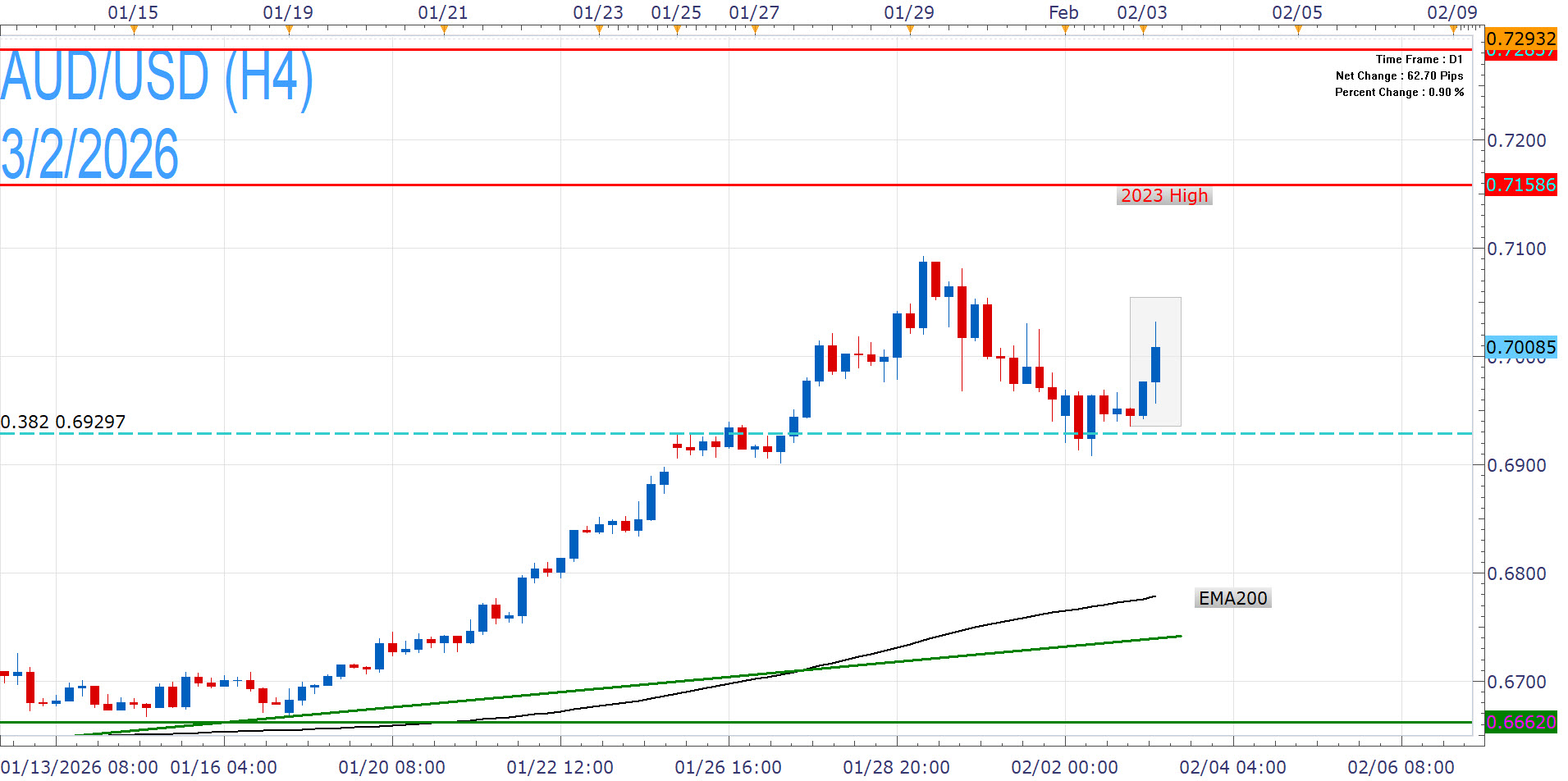
AUD/USD jumped after the hawkish decision and prospects of additional tightening have created a favourable monetary policy differential. Markets are pricing in two Fed cuts in 2026 and the USDOLLAR faces structural headwinds from broader de-dollarisation and debasement trends. After defending the 38.2% Fibonacci retracement of this year's advance, the Aussie now has scope to push towards new multi-year highs. On the other hand, AUD/USD remains vulnerable to renewed pressure towards the EMA200, which would test the bullish bias.
Despite the improvement, the Australian economy continues to face headwinds and officials lowered their GDP projections for the end of the year while highlighting uncertainty around the outlook, which could challenge the case for further hikes. Meanwhile, the greenback has rebounded in recent days and could prove resilient. The nomination of Kevin Warsh to lead the Fed has eased independence concerns and could limit the scope for monetary easing.

Nikos Tzabouras
Senior Financial Editorial Writer
Nikos Tzabouras is a graduate of the Department of International & European Economic Studies at the Athens University of Economics and Business. With extensive experience in market analysis and a strong foundation in international relations, he brings a unique perspective to financial markets. Nikos emphasizes not only technical analysis but also on fundamentals and the growing influence of geopolitics on financial trends.
As a Senior Financial Editorial Writer, he delivers comprehensive and forward-looking insights across a wide range of asset classes, including equities, commodities, and currencies. His work explores how macroeconomic events, political developments, and global policies impact market dynamics, providing readers with a deeper understanding of both short-term movements and long-term trends.
References
| Retrieved 03 Feb 2026 https://www.rba.gov.au/media-releases/2026/mr-26-03.html | |
| Retrieved 19 Sep 2026 https://www.rba.gov.au/publications/smp/2025/nov/pdf/statement-on-monetary-policy-2025-11.pdf |



Any opinions, news, research, analyses, prices, other information, or links to third-party sites contained on this website are provided on an "as-is" basis, as general market commentary and do not constitute investment advice. The market commentary has not been prepared in accordance with legal requirements designed to promote the independence of investment research, and it is therefore not subject to any prohibition on dealing ahead of dissemination. Although this commentary is not produced by an independent source, Friedberg Direct, FXCM or its affiliates takes all sufficient steps to eliminate or prevent any conflicts of interests arising out of the production and dissemination of this communication. The employees of Friedberg Direct and FXCM commit to acting in the clients' best interests and represent their views without misleading, deceiving, or otherwise impairing the clients' ability to make informed investment decisions. For more information about the Friedberg Direct's internal organizational and administrative arrangements for the prevention of conflicts, please refer to the Firms' Managing Conflicts Policy. Please ensure that you read and understand our Full Disclaimer and Liability provision concerning the foregoing Information, which can be accessed here.**